Friday, 28 December 2012

What's in a name? The paradox and the paradigm...


Dearest Emily,

Well, as you know from your Christmas visit, we have made up " Pedigree names " for our two rescue Lab's, Milly and Marley. 
So, henceforth- Miss Emilia Constance Beethoven de mieux Middleton, shall be Milly's.
and Mr Marley Jacob Eustace Offenbach de Middleton, shall be Marley's.

I'm sure you will agree these names are very suitable.

Mr Charles Lutwidge Dodgson also gave himself another name- Lewis Carroll.

His alter-ego, was suggested by the friend at 'Punch' who was assisting him in getting his 'Alice' manuscript published, and it was supposed to be an anacronym of his real name ( though there is an extra 'L' )

Mr Dodgson must have considered that this would give him some sort of pedigree too- as he had previously published his parodies and clever mathematically based barbs at people who displeased him, under his real name.

Now, with a pen-name, he could be such a clever prankster. Though he was published already, not a lot of notice had been taken of his clever jibes.

Encouraged by George Macdonald in particular and his children who enjoyed the tales, Dodgson really went to town with the preparation for this new 'Alice's Adventures Underground' manuscript.

He wrote to his friend at 'Punch', asking if he knew the illustrator John Tenniel well enough to persuade him to illustrate the work. Tenniel did agree, but finding Dodgson very hard to work with, did not want to work on the sequel- though he eventually complied. Tenniel roundly put down Dodgson as an extremely difficult man.

Dodgson curiously refused to admit he was also Lewis Carroll. He sent back any mail 'return to sender' that was addressed in this name.
He kept the duality close, only known to a select few.
A rather bizarre 'faux-pas' surrounds a rumour that following Queen Victoria's admiration of 'Alice', and request that the next book be dedicated to her- Dodgson sent her a dedicated 'An Elementary Treatise on Determinants', which I don't suppose the Monarch quite had in mind with her request...

Dodgson said nothing to address this matter for 30 odd years, only then refuting the truth of it- but as though tired of the whole charade, he mysteriously dropped the use of his Carroll pseudonym around this time also.

As we have discovered Emily, C.L.Dodgson was essentially a snobbish and aspiring social climber, who armed himself with a size-able talent for the 'new-fangled art of Photography'. This he believed would give him entree to society. Mostly, he wasn't asked twice.

He must have harboured some longings that Lewis Carroll would elevate the rather eccentric prankster's way of parodying and satirizing the luminaries he aspired entree to.

But it didn't.

Apparently no-one saw through him, or paid enough attention to do so. The Tennyson boys were probably too old as senior school boys, to bother looking at themselves as 'Tweedledum and Tweedledee'; Julia Margaret Cameron was wrapped up in the 'Idylls of the King' and then how much money she lost doing it- and then in her preparation for departing to Ceylon, and so it goes across the muse-board.

The massive commercial success of the two Carroll 'Alice' books, and Dodgson's Photographic skill and talent, still did not render him social standing, and he continued to live in protective institutionalisation at Oxford. He holidayed at Eastbourne, and preferred the company of children to adults.

Maybe the innocence and face-value aspect of childhood reflected respite from Dodgson's own sophisticated personality. His own warped intelligence and self-induced woundings, must have weighed heavily and could easily have produced a desire for fresh untainted company if only as relief for his own internal demands and complications.

His strange duality exhibited in his polite and continued dedications of his writings to Alice Liddell's Mother, Ina, though he had spitefully parodied her too as an over-bearing Mother in the character of 'Tabicat'.

Whatever he desired out of pretending he was not Lewis Carroll, except to those 'in the know' doesn't seem to have come off.

But, the fame of Lewis Carroll and indeed the social non-entity of C.L.Dodgson cover both paradigm and paradox.

150 odd years after the publication of 'Alice in Wonderland', it has never been out of fashion. Lewis Carroll along with the celebrated ignorer of Dodgson - Edward Lear- are co-joined as 'God-fathers of the Nonsense Genre'.

I wonder dear Em, what Dodgson would make of all that. Would it please him, or still frustrate him, that he was rather too clever for his own boots?

Lovely to see you this Christmas my dearest girl. Here is my latest favourite picture of you...


Your ever-loving Grand-mother, GiGi xxx


Thursday, 13 December 2012

"Why is a raven like a writing desk?"


"And the Raven, never flitting, still is sitting, still is sitting
On the pallid bust of Pallas just above my chamber door;
And his eyes have all the seeming of a demon's that is dreaming,
And the lamplight o'er him streaming throws his shadow on the floor;
And my soul from out that shadow that lies floating on the floor
Shall be lifted-nevermore!"

The Raven. Edgar Allen Poe 1845


Dearest Em,

In 1858, an anthology of Poems caused a sensation in London society, by Edgar Allen Poe. This dark mystical and fascinating poets work from across the pond; ( whose tales began to be read aloud at fancy Salons ), would send the heebie-jeebies to an eager audience thrilled by his powerfully gothic imagination provoking tales.


Poe who was born in 1809, married his 13 year old cousin who died, and then aged 40 had also left the World under questionable causes. In 1841 he published an essay on his particular form of 'cryptography'- a simple substitution cryptogram that his analytical mind saw 'that the public didn't see it'.  He was also something of an American 'Ruskin', being dubbed 'Tomahawk Man' who regularly and roundly accused Longfellow of plagiarism.

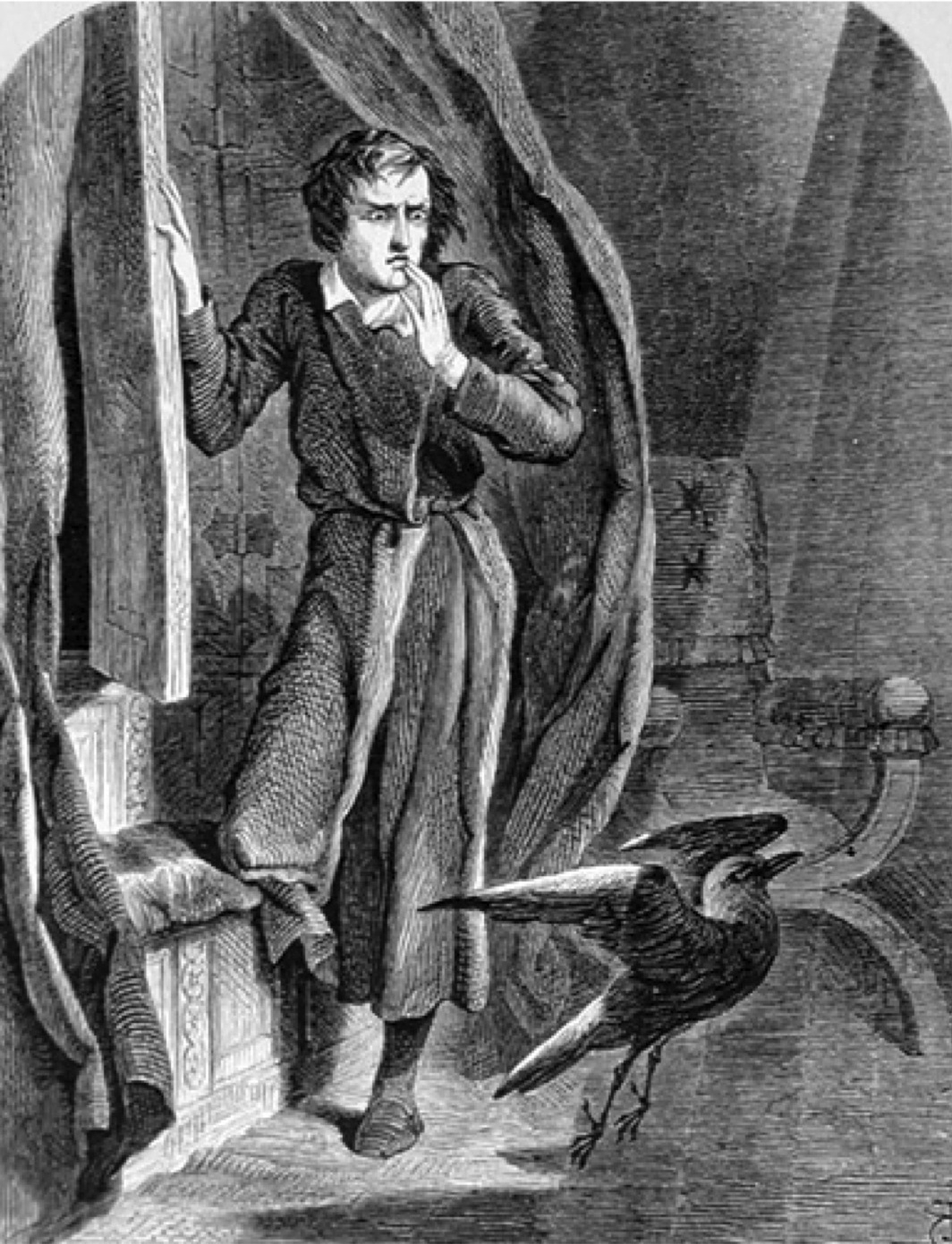
The portrait here of Poe is clearly the muse for the Chartacter illustrated by John Tenniel in the UK publication of 'The Raven' ( worked seven years before he agreed to illustrate 'Alice' ) and Tenniel says of himself that he had the ability to meet somebody once, or be shown their portrait and that was all the preparation he needed to produce an illustration. Clever chap.

Our study, then a young impressionable Charles Dodgson in his late teens and early twenties, with a keen eye for criticism, satire and parody may well have come across 'The Raven' in 1846 when it became an instant success in America.
Upon further interest in Poe and his works, he would share Poe's interest in Cryptography, Phrenology, and himself penned a parody of a Longfellow poem 'Hiawatha's Photographing' in 1857. 

The Raven itself was chosen as a 'non-reasoning creature capable of speech'. In Poe's terms this was accepted as being inspired by Dickens 'Barnaby Rudge' in which Poe felt he hadn't done proper hommage to its use.
James Russell Lowell in a 'Fable for Customs' quotes:- "Here comes Poe with his Raven, like Barnaby Rudge, Three-fifths genius, two-thirds sheer fudge. "

Enter stage-right, Lewis Carroll troubled by his own demons, writing love-poetry ( since destroyed along with some pages of his diary ) also publishing critique under a pseudonym, and obsessed with cryptography.

In 'Alice in Wonderland' at the 'Mad Tea Party' we hear 'Why is a raven like a writing desk?' posed as a riddle to Alice, who gives up. Carroll maintained that he meant this to be nonsense, however he offered up a clue years later in 1896, saying the Raven, was 'Nevar, with the wrong end in front'.

However, it would now seem pretty logical at least in the mind of Dodgson's parodic, cryptographic and satiric eye, that the 'non reasoning creature capable of speech' may indeed have sat on his writing desk. 
The Raven returns triumphant in its position in 'Alice', its third time lucky...

What say you Em?

As ever, your loving Grand-mother GiGi


Sunday, 9 December 2012

'Humpty and the Messenger'- Messrs Lear and De-Vere were here...


          'Humpty Dumpty sat on a wall
          Humpty Dumpty had a great fall 
          Four-score Men and Four score more
          Could not make Humpty Dumpty where he was before.'
Samuel Arnold's Juvenile Amusements in 1797 

Dear Emily,

Humpty Dumpty as a Nursery-rhyme has been around for a very long time. Charles Dodgson would have known perhaps the version above as a child. It was thought that the verse derived from one that lampooned Richard the third, a hump-back ( Humpty. )

Edward Lear, we have discussed before. Born 20 years earlier than Dodgson, and with his 'Book of Nonsense' published when Dodgson was in his mid-twenties, he was well-known and liked in the circles that Charles Dodgson wished to move.


Lear did not care for his own appearance, describing himself as 'spherical' very short sighted, and he walked with a stoop.
The photograph above shows a dapper Lear at the time Dodgson was writing Alice in 1862. His hair is thinning ( he was to go bald ) and at the time that 'Through the Looking Glass' was penned, Emily Tennyson and Lear were close friends, he often writing to her in his humourously self-depracating manner, joining words together and explaining- 'you are by now used to my ways'. Dodgson despite all his efforts, was not. A fastidious, easily offended bachelor, it is interesting to consider how he may have felt about the 'adorable' protagionist for nonsense-rhyme, Edward Lear. Dodgson doesn't speak about him to others, and Lear never once mentions his name to Emily in his copious correspondences. But they would certainly have been aware of each other.

Another Poet who frequented the lauded 'Tennyson circle' was Aubrey de Vere ( photographed here by our own Julia Margaret Cameron in the critical period of our interest. )


Irish-born Aubrey,  son of a poet - Aubrey de Vere de Vere - who sensibly dropped the repeat by royal license, was born in 1814. Described by the 'Irish monthly journal' as:- 'tall and slender with a calm dignified presence and sense of humour' Lear was not so enamoured with this particular buddy of Tennyson. He writes to Emily "Nor do I care, for Aubrey de Vere....He mooneth about, moodily".
In 1844 'In search of Proserpine' was published.

( Antistrophe )

' Sullen skies today,
Sunny skies tomorrow,
November steals from May,
And May from her doth borrow"

Close friend of Tennyson, Aubrey was often at Freshwater. Though Alfred was known for his resonating, booming voice, de Vere records that he would sit whilst the post was declaiming looking over his shoulder so that he could read his manuscript when his voice faltered. No-one else appeared to have trouble hearing AT, so perhaps our Aubrey was a little deaf.

Dodgson records in his diary on September 30th 1863 Bought De Vere's 'Search after Proserpine'

In 'Alice in Wonderland' we are introduced to the story in May, whereas Through the Looking Glass' begins in November. Humpty Dumpty beguiles Alice in his 'beautiful belt' or perhaps 'cravat' she cannot work out where it sits on his spherical body. Humpty takes offense at this criticism of his dress, and their discourse rambles from how important he is to the King, to how he pays words extra when he uses them together 'impenetrability' being the example. He boasts of himself that he can explain all poems. After explaining 'Jabberwocky' he tests Alice's patience with yet another poem and introduces it with-

'In winter when the fields are white,
I sing this song for your delight-'

The story goes on, introducing The Messenger to whom Humpty has to shout to in his ear.


Another day, dear Em's we shall look at the verse in 'Looking Glass' in more depth. But for now we shall continue our little journey through the Freshwater characters and their muse-value to Dodgson.

Your ever-loving Grand-mother GiGi xxx

photograph of Edward Lear by kind permission of National Portrait Gallery,

Saturday, 1 December 2012

Tweedles Dum and Dee, 'Through the Magnifying Glass'.


EPIGRAM

Some say, compar'd to Bononcini
That Mynheer Handel's but a Ninny
Others aver, that he to Handel
Is scarcely fit to hold a Candle
Strange all this Difference should be
'Twixt Tweedle-dum and Tweedle-dee!

John Byrom 1692-1763


Dearest Emily,

An epigram is a piece of short prose or text, but in verse. It is sometimes surprising or satirical. Epigrams became popularised in 16th and 17th century England, by poets such as John Donne and Alexander Pope.

Our usual suspects, the Victorian 'Artistic Aristocracy' did rather like an epigram. Tennyson was very fond of interjecting one by Hood to explain humorously in conversation, how he felt about something. We've discovered earlier how popular Hood's comic poetry was with this lot too.

The lines above are the definitive earliest reference to Tweedledee and Tweedledum, and we may assume this is where Dodgson got their names from.


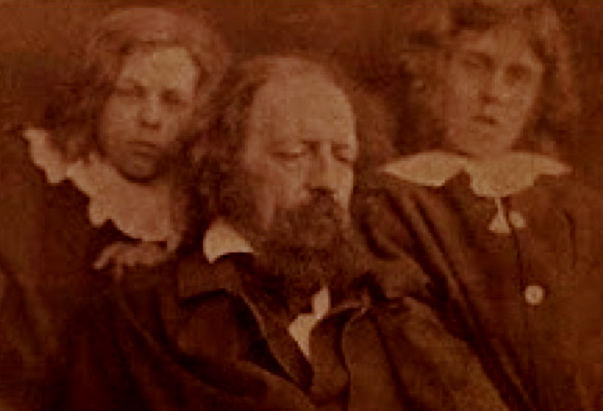
Tennysons boys were born just over a year and a half apart. Dressed in an identical fashion, of lace collars and smocks, these two were not children who were 'seen and not heard' nor did their parents adhere to the Victorian didactic of sparing the rod will spoil the child. There was virtually no punishment in the Tennyson household. The boys were their consummate delight. Unusually also, they ate with adults, and joined in adult conversation, which they were encouraged to do, and a gererally permissive attitude predominated. 'The boys ran wild' was an oft used phrase in describing them, They 'danced' they sang, banged around on the piano, and generally created loud whooping havoc. They were emotional, sensitive and thoughtful. Their parents praised 'nobility, honour and kindness' and the children took this seriously, but not much else. Studies weren't a priority. They both liked the idea of fighting. Tennyson's habit of rising the public's fervour to battle in verse displeased Emily his wife, and when Fort Redoubt was built rather jarring his view across the Freshwater Bay, he was chided as being partly responsible for the paranoia requiring its necessity.
One of the only areas in which they were 'schooled' was by an inmate at the Fort, after spending time with they often arrived home late for bed at 9pm.

Hallam and Lionel loved a bow and arrow, sword play-fighting, and repetitively singing 'Of Nelson and The North'. They had fans as well as detractors, Benjamin Jowett who we have spoken of before was not used to childrens' company. However he delighted in the boys, even writing admonitory letters ( 'NEVER FEAR. NEVER CRY.' 'AVOID SWAGGERING'. )
They weren't quite so popular with Edward Lear who showed disapproval, and had made Lionel cry. Later on when they required a Tutor, the first- a sensitive soul in between studies and career proved perfect for the boys. Later applicants could not put up with their freedoms. They must have been an unusual pair of children for the age, and were generally depicted as a pair, not one distinguishable from the other 'just after the soup we heard tiny feet in the passage and two little boys with golden hair and dove coloured frocks and large white ruffles danced into the room'. There are no recorded suggestions that the boys were ever apart from each other in their early years.

Charles Dodgson, ( not yet Lewis Carroll ) appeared fairly enamoured with them, yet saying that he did not generally favour young male children. This may have been so, or it may have been that they were the prodigy of someone he dearly wished the favoured acquaintance of. In any case it is recorded that he wrote to Hallam to cut himself ( and Lionel ) with the knife he had given them for Christmas. Emily out the knife away 'until they were older'.

Significantly for me dear Em, Dodgson often appears fascinated by them. Having first photographed them in 1857, five years before we hear of the first 'Alice' story being told to the occupants of the punt at Oxford ( Alice Liddell being the most important. )

Anyway here comes Tweedledum and Tweedledee...


These 'Blood-brothers' in Through the Looking Glass' agree to have a battle. They finish each others words, complement each other, and take flight when a menacing black crow descends.
After asking Alice if she likes poetry, they deem to find the longest poem they can...
Tennysons poems can be described as mostly not short, I think you will agree, and we shall find out more about the 'Walrus and the Carpenter' another time. 

Personally, I think the fat thing was metaphorical rather than literal.

Yours as always,

GiGi xxx

main sources used in this post- 'The Poets Wife' Ann Thwaite, image of Tennyson with Hallam and Lionel by the lovely Julia Margaret Cameron. Full credits and bibliography available with manuscript

Wednesday, 28 November 2012

Out of the 'Looking Glass' closet...


 Mr and Mrs Cameron.


Dearest Emily,

On today's post, let's start introducing the Characters. Above you will see Julia Margaret and Charles Hay. As you know, Julia lived at Dimbola Lodge and was a pioneering Victorian photographer. She first picked up a camera ( as legend goes ) when her daughter gave her one as a present, aged 48. Husband Charles had departed to check on his ailing Coffee plantations, and various children were being sent off to school.

Julia began what was to be her lifelong obsession at a time when few had mastered the process. Lord Somers ( her brother-in-law ) was respected for his efforts though he was to persue a parliamentary route. Oscar Reijlander and David Wylkie Winfield assisted Julia's practical learning of her craft- and her first supervised session was with Reginald Southey and Charles Dodgson in 1857 when they photographed the Tennyson boys. This particular photographic session was to lead to Dodgson feeling aggreived and insulted, but that I'll go into more in the book Emily. The purpose of this post is to start to show you who is who in 'Alice Through the Looking Glass'.

Julia was described as an energetic, eccentric, excitable and slightly comic. She had an 'unusual power of enjoying herself and making others do the same' Physically she was described as 'short and stout' with a loud low and husky voice. She was known for rushing around, running after people, hat-less and with shawls training. Her attitude to photography was to go at it like a 'bull in a china shop' in complete contrast to Dodgsons fastidious bachelor ways, creating pin-sharp images. Julia was not one to take criticism lying down, or to hold a grudge. She famously argued with Ruskin, and thumped him on the back, then ran after him red-bonnet flailing to continue the discussion. They later returned arm-in-arm.
Dodgson certainly did not care for her style of photography, though he did allow her to photograph him. She was always referred to as wearing long trailing shawls, held together by cameos.

In 'Through the Looking Glass' we meet the White Queen ( who at the end of the book morphs into both the Red and White Queen, which is explained later as the cat playing two parts ) she is introduced thus:-

'She caught the shawl as she spoke....in another moment the White Queen came running wildly through the wood....it would have been better, as it seemed to Alice if she had got someone else to dress her,she was so dreadfully untidy.."It can't go straight if you pin it to one side"..."dear me, what a state your hair is in"...'

And the Red Queen:-

'it takes all the running you can do, to keep in the same place...."Speak in French when you ca'n't think of the English for the thing- turn out your toes as you walk- and remember who you are!"

Julia and her sisters were remarked upon as frequently lapsing into French in their conversations. 


John Tenniel, who had 'reluctantly agreed' to illustrate 'Looking Glass' said of himself that he only had to see a picture or person once in order to draw their cariacature.

Charles Hay Cameron ( described by Tennyson as 'A philosopher with his beard dipped in moonlight' ) was a semi-invalid by the time the Cameron's came to Freshwater. He spent most of his time either reading in the garden ( in his purple dressing gown ) or huddled up in blankets in a chair. The rest of the time he spent sleeping ( probably due to the effect of opiates that numbed his pains. ) A recluse, and Julia was known to bring people up to his bedroom and show them the sleeping Charles declaring " Behold, is that not the most beautiful old man you have ever seen?"

"It's only the red king snoring" said Tweedledee "Come and look at him...Isn't he a lovely sight"

And so my dear Emily, we begin to re-introduce the characters and who they were. More on Tweedledee, Tweedledum, and 'The Walrus and the Carpenter' next time.

Lots and lots of love,
GiGi xxx

( sources for reference include Colin Ford and Graham Ovenden and are credited fully in the manuscript of the book )

Monday, 26 November 2012

Elegant Economy...

Or- here's another tangent I've gone off on.

Dearest Emily,

Whilst setting about my currently pressing quest on the book-hatching front- this being why Charles Dodgson a.k.a Lewis Carroll felt so aggrieved towards many of his peers- I decided to investigate further  as to the social stratagems and matters economical during the time of my interest.

Et voila at the Bookroom, a volume takes my eye:-

" A hundred Glorious Years " by Mrs C.S Peel

Starting with 1820, this book travels the decades detailing the social and domestic life of a century.

What fascinates me today, is just how socially mobile the 1850's to 70's were in particular.

In the 1820's 'Birth' had been everything socially. The aristocracy still maintained a sharp social difference to great county families. However, the emergence of the 'Oxford Movement' and with a sworn religious up-bringing; the canny family could keep up the supremancy of the Fashion for convention ( i.e, that everyone must behave like everyone else ) whilst contriving and upwardly mobile
position.

As example my chosen Mysterion- Mr Dodgson;

Charles' father was dubbed as the 'Eternal Curate'. The Rev C.Dodgson's home was fairly typical of what we are exploring.
A  Vicar could command an income that was deemed acceptable for marriage. £400 a year, plus an equivalent dowry from the wife, would keep five servants and therefore 'appearances' up.
Families, often with five or more children, would then struggle with constant planning, contriving and going without, in order to educate them and live in the society of their equals.

The advent of the railway popularised travels further afield than a twenty-five mile drive by carriage, and houses were expected to entertain for the total of one to two months a year. The cost was recouped by visiting others homes throughout the season.

This was done as lavishly as the familial purse allowed- 'Elegant Economy'.

Mrs Gaskell's ladies of 'Cranford' were prime examples of this maxim, their decanters filled with wines ( for guests, seldom touched otherwise.) Gooseberries and currants were gathered by the ladies of the house for syllabub, and wine that was left-over from a previous dinner party ( which may have been five months ago ) was examined, and if proven passable- added to a fresh bottle brought up from the cellar.


This kind of genteel exercise in 'not showing your slip' went on at all social levels.

One Lady of 'good birth' where means did not deem them to live in the same way as their fellows, throughout the season lived in Eaton Square, kept a carriage and gave dinners. In the summer the front windows were papered- the family went out of town.
In reality, they dismissed the servants, ceased to job a carriage and inhabited two or three rooms at the back of the house, were waited on by a charwoman and lived on toast, tea and poached eggs, their letters being forwarded from a country address.

Charles Dodgson was a child of parents who strove for a good education for him and his many siblings.
Extraordinairily gifted at mathematics, but not disposed to studying hard- he breezed Oxford and attained honours. He was offered a Lecturers position in Mathematics, which meant a salary of about £70 a year. At this time this was a popular choice ( comparable perhaps to a contemporary sabbatical ) whilst one decided one's path. Thomas Carlyle did the same in Edinburgh whilst he wrestled with his religious beliefs. )

A Fellowship was offered to Dodgson, upon condition that he did not marry, and took holy orders. This must have seemed financially attractive to the Reverend's son- though he too struggled with divinity- and a stammer that made him anxious about reading sermons.
However smart and admirable a clever Mathematics Fellow of Oxford may seem to us now, at the time it was Art that held lofty intellectual prowess.
Parliamentarians were seconded by Lord Lansdowne from poets, painters and writers. Lord Somers ( married to Julia Margaret Cameron's sister Virginia ) was 'press-ganged' by Lansdowne into government, so his career as a painter and photographer was put firmly on the shelf.

Mathmatical Dodgson didn't have much social cachet, and felt the need for another social string to his bow. What better way to get up close and personal with the peers he wished to impress, than to ingratiate them via the new-fangledart of photography?

In 1855, years before 'Alice in Wonderland' was written, he and Reginald Southey ( son of Robert am ex-poet laureate ) went together to Covent Garden where Dodgson bought his first camera for fifteen shillings. Of which, dear Emily, more another time.

What I have enjoyed most Em, in this little soujourn into 'Elegant Economy' is how the whole idea contrasts with todays 'Facebook-pretty', Twitter-friendly espoused aspiration or political or social exascerbation is set to attract the 'likes'- minded towards them.
It's all pretty socially democratic.
Unsettled attempts at re-settling in unsettled times.
But, uncertainty is an ally.
Just as it was for the Victorians with the scenery of Napoleonic and Crimean wars, the French revolution, economic paranoia, social upheaval and social conscience.
There's a lot for us to learn today from the previously considered 'stuffy' Victorians. But here, I may be prejudiced in seeing them in this way. It's a generational thing.

As a child of the 11 plus exam, by passing and going to a 'Grammar school' my achievement rather dampened any literary hunger or appreciation. Shakespeare had to be learned by 'rote' and poetry was an all too gloomy affair with 'modern-verse' often focussed upon the horror of the two world wars.

Though I chose English Literature for A-level, I dumped it within six months and headed for the fashion industry where my hunger fort learning was satiated throughout my twenties.

In my thirties, I was woken up to Shakespeare by the redoubtable Dorothea Alexander I have told you of previously. I was ordered to 'put away my spines' as she sat me down on a kneeler beside her whilst I read aloud. The penny dropped and the stories suddenly became alive and related to the world around me.

As do the Victorians for me now, and what we can learn from them...

I rather like 'Elegant Economy' Emily, I think it's rather truthful.

I have decided anyhow that my recycled dogs, car, bicycle, clothing and I'd better say 'upcycled' husband, should indeed qualify as an elegant economy!


Adoringly yours,

GiGi xxx


Thursday, 22 November 2012

Thursday's child.

Dearest Em,

The photograph above is of Julia Margaret Cameron's home at around the time she lived in it. Mrs Cameron had not yet picked up a Camera, or so the story goes- though GiGi rather thinks she had- until a good three years after she moved here.

The building ( which is at the beginning of our Terrace ) was two houses, owned by a property speculating Fisherman named Jacob Long. Mrs C, had set her cap at following Tennyson and family down to Freshwater at every given opportunity beginning in 1855  and continuing throughout the late fifties ( excerpt from Emily Tennyson's diary in November 1857 " Mrs Cameron runs after us and comes with us ". ) The family had made several visits already that year, beginning in February for a month, then in April for Tennyson's brother Horatio's wedding to Charlotte Elwes at Bonchurch.

Julia bought the two houses ( possibly one was called 'Lingland' ) and whilst they were being joined together with the addition of the Tower in the middle, she staid at Ashburton Cottage in July 1859.

This was a year before plans were approved for the two roads in the picture- Terrace Lane and Gate Lane. Originally there were plans to run the main road ( Gate Lane ) up where our Terrace is and around the back of Farringford, but a helpful local Gent, Mr Cotton, offered the Tennysons half of the money needed to pay off the landowner of 'Starks' so that the road could by-pass the front of Farringford Hall.

Julia and co set up camp and named one half 'Dimbola' after her adored husband Charles Hay Cameron's Coffee plantations in Ceylon. Mr Cameron had been thus far unsuccessful at obtaining a Governance post anywhere, and Julia must have been beginning to worry about future finances. Charles was frequently yearning for Ceylon, and it's not too far-fetched to think that Julia had designs on keeping him nearby by giving them a home on a small Island near the sea. Charles however promptly became a scholarly invalid, rarely setting foot outside the grounds. He slept a lot by all accounts, and was often recorded as 'quoting classics' wearing a purple dressing gown with his long silver-grey hear and beard enhancing an unworldly appearance in the garden. Beards were all the rage in the early 1860's after poet friend of Julia's Henry Taylor grew one. Tennyson followed, Darwin too, and clean-shaven was not the thing. Acid purple dye had also recently become commercially viable, and Mrs C was fond of bright colours.

So that is how Julia Margaret Cameron came to Freshwater, and over the next decade she certainly made her mark. Her family ( The Pattles of Indian and French sophisticated society ) had long been used to the French 'Salon'. London houses were on the whole a bit small for this kind of entertaining, but Julia found Dimbola an excellent venue for hers. Her exhuberant personality and effusive friendship, made her a hard woman to refuse. This helped once she picked up a camera, and the legacy of Eminent Victorian portraits she gave us bears witness.

Your Grand-mother came across Dimbola this way...

Grumpa and GiGi had wandered down to the Isle of Wight one bank-holiday weekend in 2005. Making it a place we could call our own, we stayed regularly at a hotel in the Bay. It felt familiar to me particularly, and I recognised various paths, and landmarks, having forgotten that my father brought me here as a small child in the late 60's.

I had often felt a strong desire to turn right out of our hotel and explore. Grumpa didn't want to.

One day, when Grumpa had gone out with the children, I followed my instinct.

I walked up Gate Lane, and without knowing anything about Dimbola, went in.


This is the first picture I saw.

It didn't strike me as a Victorian photograph at all. Looked rather like Vincent Gallo. Then I saw a photograph of Julia Duckworth that reminded me of Virginia Woolf. I had long been fascinated by the Bloomsbury set, and now discovered that Julia was Virginias Aunt. The 'Bloomsbury set' came along a generation after this lot often referred to as the 'Cosmopolitan club'. I was smitten from this point. Dimbola felt familiar, and I was very pleased I had arrived there.

Seven years on, and a lot of things have changed. Here we are, living at a house in the same road as Dimbola, and still discovering more about the lady of the house, her friends and compatriots.

Your bedroom here is called 'Emily' after you. Horatio Tennyson lived here for some time as H.J.Jennings wrote to Tennysons son Hallam 'Horatio - seventh brother of the poet who is resident at 'The Terrace', close to Mrs Cameron, who is devoting his life to ministering among those in any ways afflicted in mind, body or estate' winning the wanderer back into the fold by showing them he still counts them his brethren in Christ.'


Horatio Tennyson.


Enough for now Emily, looking forwards to you coming here over Christmas and seeing how much you have grown!

Your ever-loving Grand-mother GiGi! xxx